
Most lifters do not lack effort, they lack structure. They train hard, push themselves, and spend hours in the gym, but their results are inconsistent. Strength goes up for a short period, then stalls. Fatigue builds, performance drops, and progress becomes unpredictable. The issue is not how hard they train, it is how their training is organized.
Strength is built through repeated exposure to the right stimulus, applied in a way that can be recovered from and progressed over time. Without structure, even good training methods fall apart. This is where weekly organization becomes critical.
Why Weekly Structure Matters
Your body does not respond to individual workouts in isolation. It responds to the accumulation of stress and recovery across days and weeks. If intensity is too high too often, fatigue outpaces adaptation. If training is too light or inconsistent, the stimulus is not strong enough to drive progress. The goal is to create a balance between stress and recovery that can be sustained over time.
Weekly structure is what allows that balance to exist. It determines when you push, when you build, and when you recover. Without it, training becomes random, and random training produces random results.
The Three Pillars of a Strength Training Week
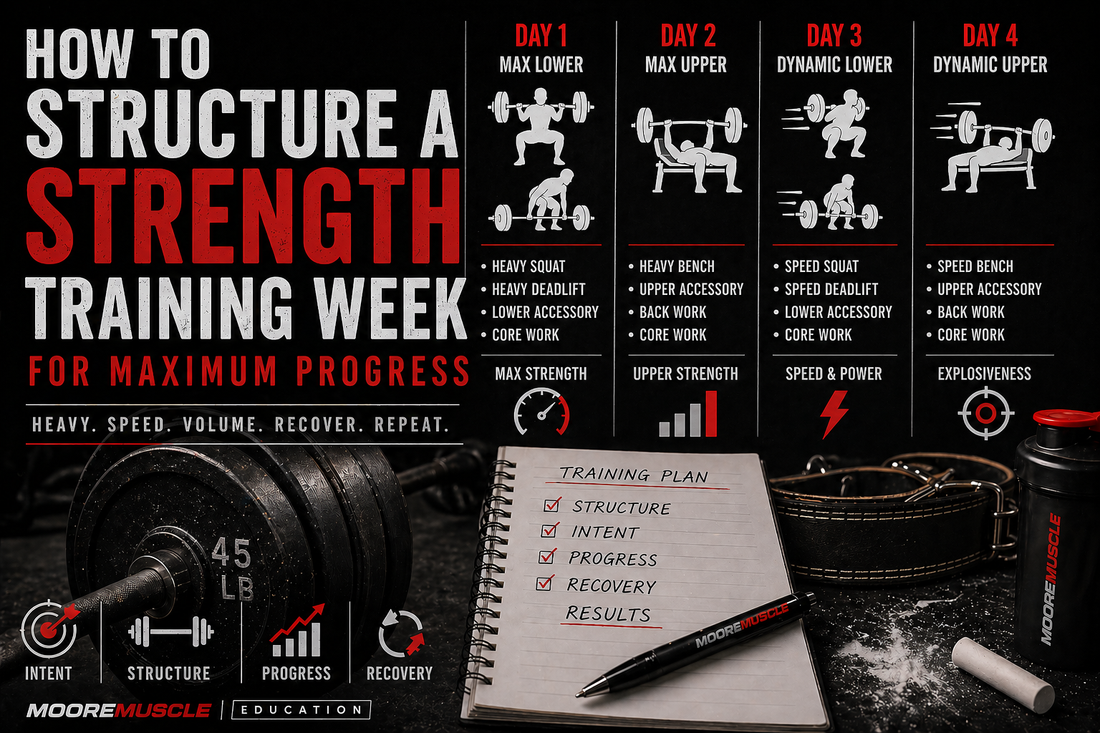
Effective strength training is built around three distinct types of work, each serving a different purpose. Heavy effort work develops maximal strength by forcing you to produce high levels of force under load. Speed and dynamic work improves rate of force development, emphasizing bar speed, intent, and explosive execution. Volume work builds muscle, reinforces technique, and increases your capacity to handle more work over time.
When these elements are balanced correctly, they support each other. When they are not, progress slows or stops.
A Practical Weekly Structure
There are many ways to organize a training week, but the key is separation of stress. High-intensity work needs to be balanced with lower-intensity, higher-quality work so you can continue to perform and recover.
A simple and effective structure includes a max effort lower day, a max upper day, a dynamic lower day, and a dynamic or intensity upper day. On lower days, both squat and deadlift variations should be trained to develop total lower body strength. Upper days focus on pressing strength, upper back development, and accessory work that supports the main lifts.
This type of structure allows you to train hard without constantly accumulating fatigue in the same way. It creates space for recovery while still driving consistent progress.
Where Weak Point Training Fits
Your main lifts are only as strong as their weakest positions, which is why targeted accessory work is essential. Weak point training should follow your primary work, when the movement pattern is already reinforced. The goal is to strengthen the exact portion of the lift that limits you.
If your squat breaks down out of the hole, your accessory work should reflect that. If your bench stalls off the chest or your deadlift fails at lockout, your training needs to directly address those issues.
Using Progress Tracking to Guide Structure
Structure is not static. It should evolve based on how your body responds to training. If bar speed is improving, execution is consistent, and loads are progressing, your structure is working and you should stay the course.
If performance is declining, fatigue is accumulating too quickly, or specific weak points are not improving, adjustments need to be made. This is where tracking becomes critical, because without it, you are making decisions based on feel instead of evidence.
Common Mistakes in Weekly Programming
Most programming mistakes come down to imbalance. Too much intensity leads to excessive fatigue and inconsistent performance, while too much volume without purpose leads to wasted effort. A lack of structure almost always leads to stagnation.
Another common issue is chasing exhaustion instead of progress. Hard training is not the goal. Effective training is. The best programs are not the ones that feel the most difficult in the moment, they are the ones that produce consistent results over time.
Structure Creates Opportunity
Once your training is structured correctly, your results become more predictable. You know when to push, when to build, and when to adjust. Strength stops feeling random and starts becoming something you can control.
This is where most lifters stop, expecting everything else to fall into place. But there is another layer.
The Next Step: Fueling the System
Even the best training program will fail if it is not supported properly. Your ability to recover, adapt, and perform is heavily influenced by how you fuel your body. Nutrition is not separate from training, it is what allows training to work.
If your weekly structure determines the stimulus, nutrition determines how well you respond to it. In the next series, we are going to break down sports nutrition for strength athletes and show you how to fuel performance, support recovery, and build strength more effectively through what you eat.
Once your training is structured correctly, nutrition becomes the next lever for progress.
MooreMuscle Education is built for lifters who want structure, not guesswork. Train with intent. Build strength that carries over.